
How an Bathtub is Built
Acrylic tubs are thermoplastic engineering. A sheet of Polymeric Methyl Methacrylate (PMMA), typically 3–4mm thick, is heated to 120–150°C until pliable, then vacuum-formed over a mold. A 4mm shell cannot carry sixty gallons of water plus an adult, so the underside is reinforced with a 4–5mm matrix of woven fiberglass and polyester resin.
The result is resilient. Fiberglass backing absorbs impact instead of shattering, and UV inhibitors in quality PMMA prevent the yellowing that ruins cheap fiberglass units.
A solid surface bathtub is the opposite
- Monolithic, homogenous from outer skin to core.
- High-end production uses roughly 33% resin binder to 66% finely ground natural minerals.
The premier binder is Alumina Trihydrate (ATH) — non-toxic, halogen-free, chemically inert, and unreactive to bath salts or aggressive cleaners. The ATH is amalgamated with natural aluminum powder, vacuum-degassed to eliminate microscopic air pockets, then cast and cured at room temperature. The output has the density, visual gravity, and tactile weight of quarried stone, which is why solid surface tubs reads as stone bathtubs to the eye and hand.
Parameter |
Acrylic (PMMA + Fiberglass) |
Solid Surface (ATH + Minerals) |
|
Structure |
Laminated composite layers |
Monolithic, homogenous body |
|
Density |
1.7 g/cm³ |
1.17 g/cm³ |
|
Manufacturing |
High-heat vacuum thermoforming |
Room-temperature vacuum casting |
|
Resilience |
High elasticity; resists shattering |
Extreme rigidity; resists flexing |
|
Texture |
High-gloss, plastic-like |
Matte, stone-like |
Total Cost of Ownership
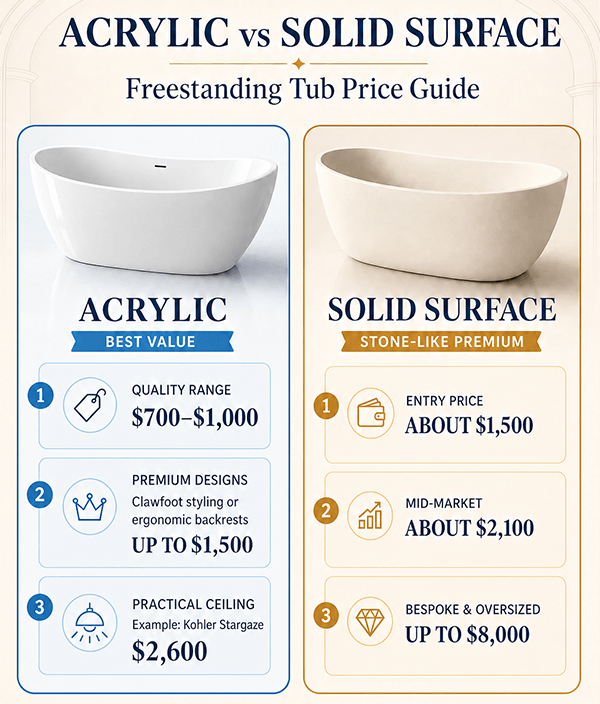
Installation |
Lifespan |
|
| Acrylic | It weighs under 100 pounds empty. One contractor can carry it up a narrow stairwell without lifting equipment. | It is durable but consumable: expect 10–15 years before the surface dulls or flexing forces replacement. |
| Solid Surface | It is massive. A 67-inch stone bathtub in solid surface can exceed 300–400 pounds empty. That mandates a multi-person crew and higher labor hours. | It has an indefinite service life, and because the material is prized in luxury real estate, a pristine unit behaves as an asset that supports property valuation across a 20-year horizon. |